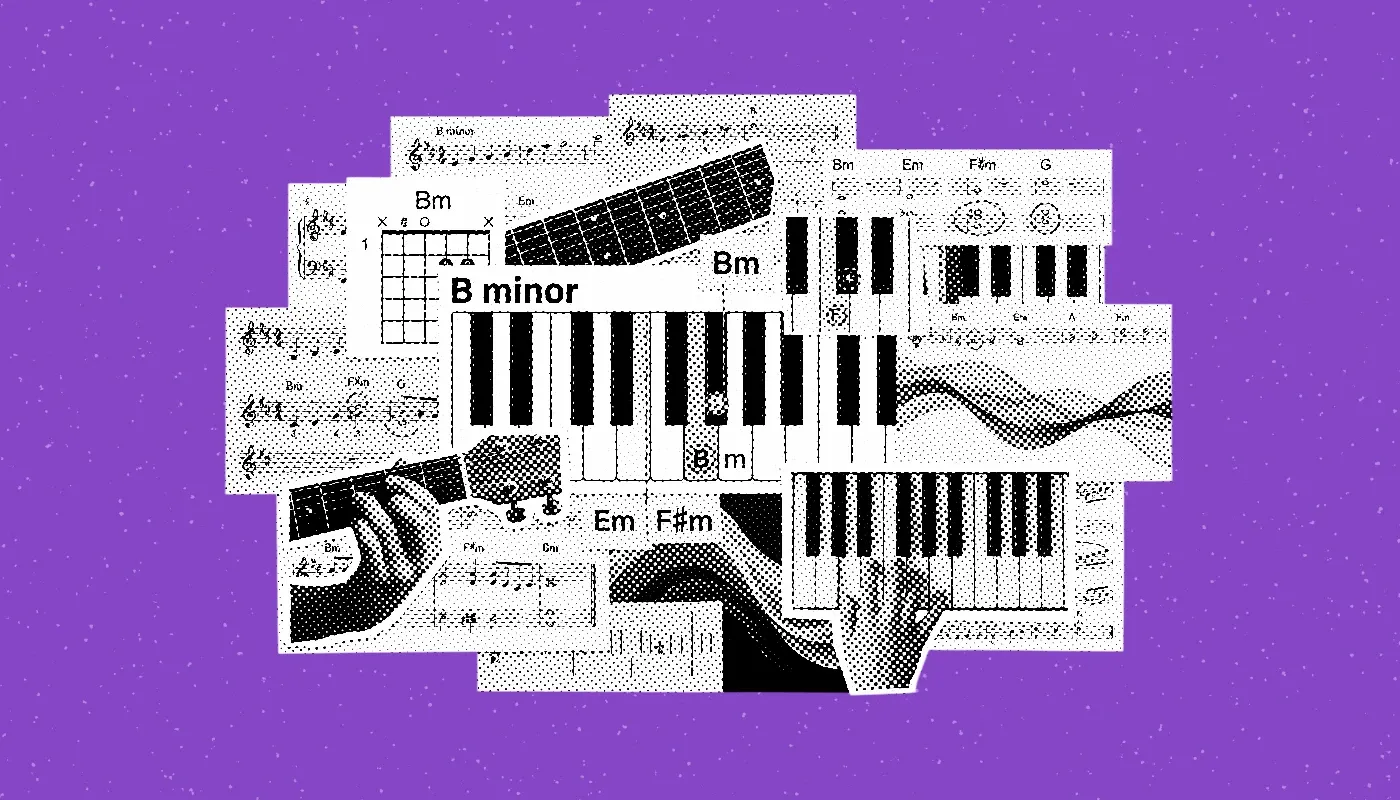
Chords in B Minor: Quick Overview
Discover how to master B minor chords, their role in music theory, and how to use them in your own compositions. This is the definitive 2026 guide for beginners and digital music producers.
Introduction: What are the chords in B Minor?
The key of B Minor contains seven diatonic chords: B Minor (i), C# diminished (ii°), D Major (III), E Minor (iv), F# Minor (v), G Major (VI), and A Major (VII). In modern songwriting, the F# Minor is often replaced by F# Major (V) to create a stronger harmonic pull toward the tonic.
At a Glance: Core B Minor
- Relative Major: D Major
- Key Signature: 2 Sharps (F#, C#)
- Parallel Major: B Major
- Primary Scale (Aeolian): B - C# - D - E - F# - G - A
What Notes are in the B Minor Scale?
The B minor scale is the foundation for all chords in this key. It consists of seven notes derived from the Aeolian mode (natural minor).
- B Minor Scale Notes: B, C#, D, E, F#, G, A.
- Scale Structure: Whole Step, Half Step, Whole Step, Whole Step, Half Step, Whole Step, Whole Step.
Understanding these notes allows you to build triads (three-note chords) by stacking thirds. For a dinner dive into the very foundation of music theory, read our article on scales, intervals, and building chords.
Chords in B Minor: The Diatonic Reference
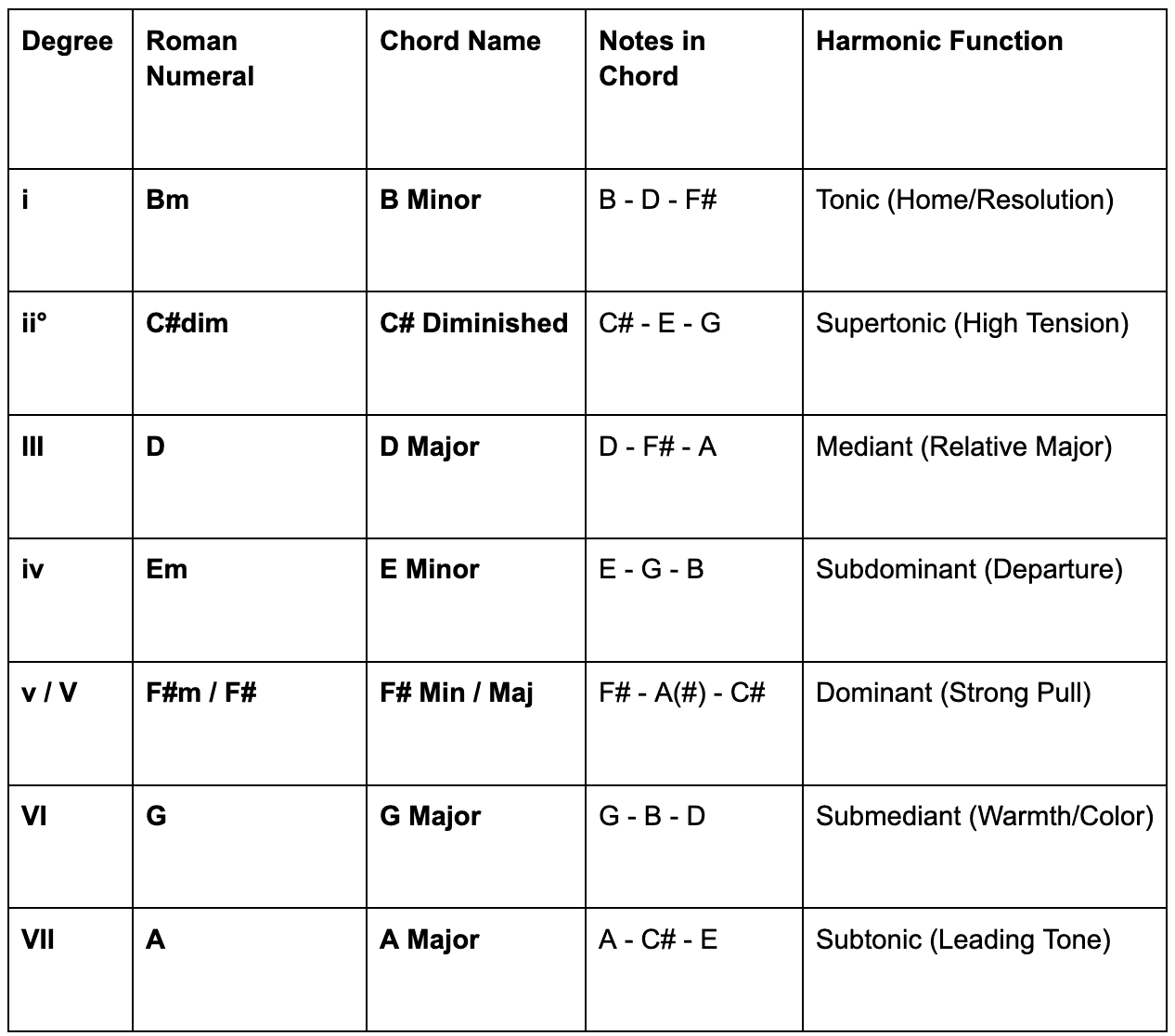
Exploring Harmonic and Melodic Minor Variations
To add more depth and "exotic" or "classical" flavors to your B Minor songs, you can modify the 6th and 7th degrees.
1. B Harmonic Minor
By raising the 7th note (A to A#), you create a "Leading Tone." This allows you to use an F# Major (V) chord instead of an F# Minor chord, creating the iconic "V-i" resolution heard in everything from classical music to pop and heavy metal. It’s the most conclusive musical punctuation.
The interval from the Major Dominant to the Tonic occurs naturally in a major scale, given the way these scales are constructed. To achieve the same sense of conclusion and finality in a minor key, you need to alter the 7th note of the scale, which gives us this leading tone.
The notes with a raised seventh then become: B, C#, D, E, F#, G, A#.
2. B Melodic Minor
This scale raises both the 6th and 7th degrees (G# and A#) when ascending, providing a smoother, more "jazz-like" melodic climb toward the tonic. When descending, it reverts to its regular minor note pattern.
Notes (Ascending): B, C#, D, E, F#, G#, A#
How B Minor Chords Function in Popular Music
Each chord has a "job" to do. Here are examples of how some famous songwriters use them.
The Tonic (i): B Minor
The "home" chord. It provides stability.
Example:
There There establishes a dark, grounded atmosphere by sitting on the B minor chord for the intro.
The Mediant (III): D Major
The relative major. It adds an uplifting contrast to the minor key.
Example:
Avicii - Wake Me Up This song uses the D Major chord to create an anthemic, hopeful feel within a minor progression.
The Dominant (V): F# Major / F# Minor
The "driver." This chord creates the tension that makes the return to B Minor feel satisfying.
Example:
Hotel California uses a Dominant 7th (F#7) to create that signature sense of longing and melancholy.
Advanced Textures: 7th, Augmented, and Suspended Chords
To move beyond basic "beginner" sounds, you must introduce chromaticism and extensions.
1. Seventh Chords in B Minor
Adding the 7th interval adds "emotional weight" or "jazz" flavor.
- Bm7 (i7): B - D - F# - A (Mellow, introspective)
- C#m7b5 (iiø7): C# - E - G - B (Mysterious, tense)
- F#7 (V7): F# - A# - C# - E (Maximum tension/pull)
Read more about Seventh Chords in B Minor here.
2. Suspended Chords (sus2 and sus4)
"Sus" chords replace the 3rd (the note that makes it major or minor) with a 2nd or 4th. This creates an "unresolved" sound perfect for ambient music or cinematic scores.
- Bsus4: B - E - F#
- Asus2: A - B - E
3. The Power Chord (B5)
In rock and metal, we often strip the 3rd entirely to avoid "muddiness" under distortion. The B5 (B - F#) is the "bread and butter" of heavy riffs.
How to Use Chord Inversions for Smooth Voice Leading
Inversions put a note other than the root in the bass. This prevents your hand from "jumping" all over the keyboard or fretboard.
- Root Position: B in the bass (B - D - F#)
- 1st Inversion: D in the bass (D - F# - B)
- 2nd Inversion: F# in the bass (F# - B - D)
Pro Tip: Use inversions to create a "walking bassline" while your chords stay relatively still. This is a hallmark of sophisticated songwriting.
Read our article “Learn Chords in B Minor” for a much more detailed guide in this key signature. It features audio examples and chord progressions to put all this knowledge into practice.
Frequently Asked Questions (FAQ)
1. What is the relative major of B minor?
The relative major of B minor is D Major. They share the same key signature (two sharps: F# and C#).
2. What are the most common chord progressions in B minor?
Common progressions include i - VI - III - VII (Bm - G - D - A) and i - iv - V (Bm - Em - F#).
Does B minor have sharps?
Yes, B minor has two sharps: F# and C#.
4. Why should I learn music theory?
Put simply, music theory helps you take the guesswork out of songwriting. It allows you to make more sense of each note on your instrument in the context of your music. Having only a brief understanding of music theory helps you write music with intention and take it to where you want it to go without the countless trial-and-error.
Read more about why music theory matters in songwriting in our article “How Music Theory Can Improve Your Songwriting.”
Join The Musiverse: Your free space to connect, create, and compete.
Collaborate with global creators, level up in live workshops, and win exclusive prizes. Join the community today!
Join The Musiverse
Collaborate with global creators, level up in live workshops, and win exclusive prizes. Join the community today!
Your Music, No Limits.
Join the Waitlist