A Comprehensive Guide to Music Theory for Beginners: Intervals, Scales & Chords
Learn the basics of music theory to level up your songwriting. This guide breaks down the "big three" – intervals, scales, and chords – to help you stop guessing and start choosing the exact sounds that trigger an emotional response in your listeners.
Introduction
Music theory often gets a bad rap. To many, it sounds dry, academic, and rigid – the very opposite of the creative spark that leads us to pick up an instrument or open a Digital Audio Workstation (DAW).
However, theory isn't a set of "laws" you must follow; it is a map that helps you make sense of what you’re hearing or playing. It describes why certain note combinations make us feel like we’re flying through the sky, while others make us feel trapped in a suspense thriller.
By understanding these three pillars of music – intervals, scales, and chords – you gain the ability to communicate with sound in a much more sophisticated way. You stop "guessing" which note comes next and start "choosing" the exact emotion you want your listener to feel.
A little music theory gives you much more control over your music.
1. The Building Blocks: Notes, Steps, and Intervals
In Western music, every song you have ever heard – from the complex symphonies of Beethoven to the minimalist pop of Billie Eilish – is built from just 12 unique notes. These 12 sounds are the DNA of all modern (Western) harmony.
The Musical Alphabet and Octaves
The core of our system uses the first seven letters of the alphabet: A, B, C, D, E, F, and G. Once you reach G, the cycle repeats at a higher pitch. This repetition is called an Octave. If you play a "Low C" and a "High C" at the same time, they sound identical in character but different in "height."
The Gaps: Sharps (#) and Flats (b)
Between most of these lettered notes live the "accidental" notes.
- A Sharp (#) is the note one small step higher than A.
- A Flat (b) is the note one small step lower than A.
One of the most confusing hurdles for beginners is the concept of Enharmonic Equivalents. This is the fancy way of saying that A# and Bb are the exact same sound. Whether you call it a sharp or a flat usually depends on the "Key" you are playing in.
Measuring Distance: Half Steps and Whole Steps
Instead of measuring music in inches or centimeters, we measure in "steps."
- Half Step (Semitone): This is the smallest possible distance between two notes. On a piano, it’s moving from a white key to the very next black key (or B to C).
- Whole Step (Whole Tone): This is two semitones put together (e.g., C to D).
The No-Gap Rule: It’s important to remember that there is no sharp or flat between B and C, or between E and F. They are naturally only a half-step apart. If you look at a piano, you’ll notice there are no black keys between these pairs.
2. Intervals
An interval is simply the distance between two notes played either together or in sequence. Understanding intervals is the secret to "ear training" – the ability to hear a melody and know exactly how to play it.
Here are some of the most important intervals to learn, especially when it comes to chord construction:
- The Major 3rd (4 Semitones): This is the "Happy" interval. It is the core of every Major chord. It sounds bright, stable, and optimistic.
- The minor 3rd (3 Semitones): This is the "Moody" interval. It is the foundation of the minor chord, sounding sad, serious, or introspective.
- The Perfect 5th (7 Semitones): This is the most stable interval after the octave. It sounds "hollow" and powerful. In modern music, "Power Chords" are simply a Root note and its Perfect 5th.
- The Major 7th (11 Semitones): This interval is right on the edge of the octave. It sounds "dreamy" and sophisticated, often used in Jazz and Lo-fi music.
By learning to recognize these distances, you can begin to identify the "flavor" of a song just by listening to the gap between notes.
To identify intervals by ear, try associating them with iconic songs. For instance, the tense minor second (half-step) is immortalized in the Jaws theme, while the heroic perfect fifth is instantly recognizable as the opening leap of the Star Wars Main Title."
3. Scales
A scale is a specific pattern of whole and half steps that creates a musical "palette." When you choose a scale, you are essentially choosing the "colors" you will use for your song.
The Major Scale (The Formula: W-W-H-W-W-W-H)
The Major scale is the most common sound in Western music. It feels resolved and familiar. If you start on C and follow this formula of steps, you’ll get the C major scale.
C Major: C - D - E - F - G - A - B - C
The Natural Minor Scale (The Formula: W-H-W-W-H-W-W)
The Minor scale sounds darker and more dramatic.
A Minor: A - B - C - D - E - F - G - A
The Relative Minor Connection
A common "lightbulb moment" for beginners is realizing that C Major and A Minor use the exact same seven notes. They just start on a different "Home" note.
- C Major starts on C (The 1st degree).
- A Minor starts on A (The 6th degree of C Major).
Every Major key has a Relative Minor. This is why songwriters can easily switch a song from a "moody" verse to a "happy" chorus without changing the notes they are using – they simply shift the focus between the C and A as the “home” or tonic (root) of the scale.
In other words, they start treating the 6th chord of the scale as the new “home” temporarily if the song is primarily in C major key (learn about “keys” further down).
4. Chords
A chord is three or more notes played simultaneously. The most basic chord is a triad, built by "stacking thirds." This means you pick a starting note (the Root), skip the next note in the scale, pick the third, skip the fourth, and pick the fifth.
Major vs. Minor Triads
The difference between a Major and minor chord is entirely determined by that middle note (the 3rd).
- Major Triad: Root + Major 3rd + Perfect 5th (Bright/Stable)
- Minor Triad: Root + minor 3rd + Perfect 5th (Dark/Moody)
Diminished Chords
When you stack two minor 3rds on top of each other, you get a Diminished Chord. It sounds tense and "wants" to resolve to a more stable chord.
Augmented Chords
When you stack two Major 3rds on top of each other, you get an Augmented Chord. If the diminished chord feels "squeezed," the augmented chord feels "stretched." Because it lacks a stable 5th, it sounds more ethereal, mysterious, and slightly surreal. It is often used to create a sense of wonder or as a "bridge" that suspends the music in mid-air before landing on a new section.
Take a look at these articles to learn more about chords in C major and Chords in A Minor. We also have resources on the chords in all keys, where you can learn about everything from the basic chords, chord extensions, suspended chords, and ways to make chord progressions even more interesting and engaging.
5. The Key and Chord Progressions
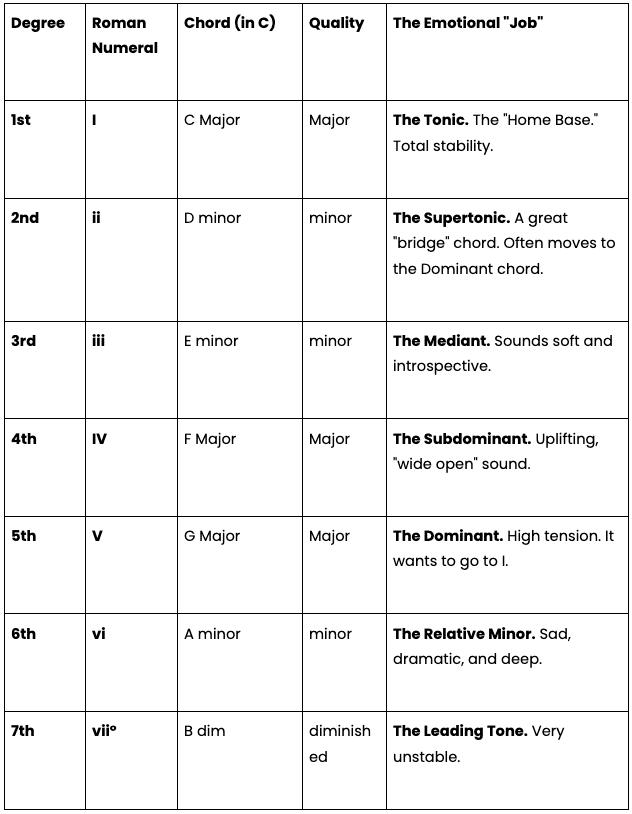
Think of a Key as a family. In any Major key, you have seven notes, and each of those notes serves as the foundation for a chord. Because we must stay within the notes of the scale, the "quality" of each chord (Major, minor, or diminished) is already decided for you.
The Chord Alphabet (Roman Numerals)
Musicians use Roman Numerals to describe chords so they can talk about songs regardless of the key. Uppercase means Major; lowercase means minor.
6. The "Secret Sauce": Tension and Release
All great music utilizes tension and release, or a sense of "push and pull." If a song stayed on the I chord (Home) the whole time, it would be boring. If it stayed on the V chord (Tension), it would be exhausting.
The V chord (Dominant) is like a question; the I chord (Tonic) is the answer. By moving between only these chords, you can control the listener’s emotions. This is why the V → I resolution is the most powerful move in music. It answers a question and often completes a musical phrase.
7. Chords in Practice
How do you use all this information to actually write a song? Here are three classic "Roadmaps" used by the world's biggest artists. Listen to these chord progressions and pay attention to the sonic quality of each chord in relation to the previous and the following chord.
The Classic (I - IV - V)
- Key of C: C - F - G
- Why it works: This is the foundation of Rock, Blues, and Country. It feels honest, direct, and grounded. Try playing the I and IV back and forth for a "dreamy" verse, then hit the V for a "soaring" chorus.
The "Pop Progression (I - V - vi - IV)
- Key of C: C - G - Am - F
- Why it works: This progression is used in "Let It Be," "Don't Stop Believin'," and "Someone Like You." It takes the listener on a complete emotional journey: Home → Tension → Shadow → Uplift.
Starting on the Minor 6th (vi - IV - I - V)
- Key of C: Am - F - C - G
- Why it works: By starting on the vi (minor) chord, the song immediately feels more serious or "cool." It provides a sense of drive and modern drama.
For a deeper dive into chord progressions in various keys, check out our music theory articles on chord progressions.
8. Developing Your Ear: Melody Tips
When you write a melody over your chords, remember the difference between Chord Tones and Passing Tones.
- Chord Tones: If you are playing a C Major chord (C-E-G), singing the note "E" will sound very stable and pleasant.
- Passing Tones: If you sing a "D" over that C Major chord, it creates a slight tension. The "D" wants to "pass through" to the C or the E.
The best melodies use a mix of both. Use chord tones for the important words you want to emphasize, and use passing tones to create the "flow" between them.
You can become a Musiversal Community member (for free) and check out a workshop we did with professional songwriter Clare Dove on writing top lines – the most notable melodic part of your song.
Conclusion: Theory is a Tool, Not a Cage
The most important thing to remember is that if it sounds good, it is good. Music theory is simply a way to categorize things that humans have found pleasing for centuries. It gives you a common language to speak to or collaborate with other musicians and a shortcut to finding the sounds in your head.
Now that you understand how scales build chords and how chords build keys, the next step is to analyze your favorite songs.
Look up the chords to a song you love and try to identify the Roman Numerals. Is it a I - V - vi - IV? Is there a "moody" chord in the bridge?
Once you start seeing the patterns, the "magic" of music doesn't disappear – it becomes something you can finally reach out and touch.
Join The Musiverse: Your free space to connect, create, and compete.
Collaborate with global creators, level up in live workshops, and win exclusive prizes. Join the community today!

Join The Musiverse
Collaborate with global creators, level up in live workshops, and win exclusive prizes. Join the community today!
Your Music, No Limits.
Join the Waitlist